
 mainwp
12 Jan
mainwp
12 Jan
Period Property Wallpaper Restoration in Surrey
Every restoration project undertaken by historic property owners focuses on preserving original interior designs.
Architects who restore historic buildings need to safeguard visual elements through established procedures that protect traditional building methods.
The company Surrey Painters serves clients through specialized services which maintain historic wallpaper integrity by using present-day safety measures throughout London and Surrey areas.
Why Period Wallpaper Demands Specialist Care
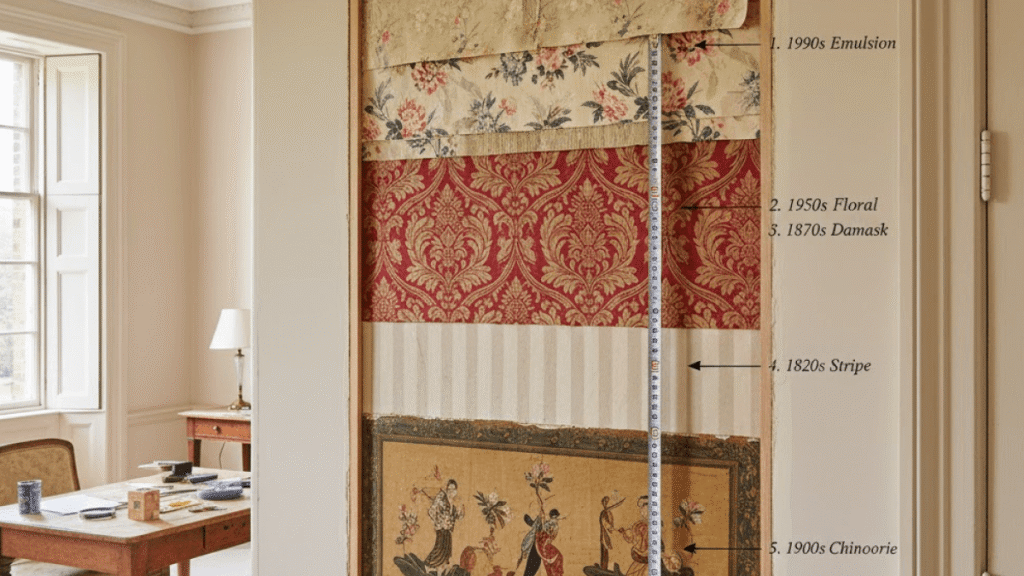
The installation of wallpaper has evolved since the past because antique wallpaper had to use mortar and animal glue for bonding on lime-plastered walls.
The absorption of water into walls through defective paint applications leads to permanent wallpaper damage when patchwork causes mold to grow under protective finishes.
The 2008 Principles for the Conservation of England’s Historic Heritage mandate that all work conducted on listed buildings meets these four fundamental protection guidelines:
- Every restoration project must keep core materials safe.
- The approach to restoration must allow for easy material extraction.
- The materials used for restoration must be perfect copies of the original ones
Complete documentation of restoration methods is necessary to protect future needs because the information becomes essential for maintaining the structure.
Conservation principles that are ignored lead to planning deficiencies which trigger legal consequences because the breach of planning permission occurs.
The Planning Act (Architectural Monuments and Protected Areas) 1990 grants legal power to stop unauthorized changes made to Grade II and Grade I architectural monuments listed as protected buildings.
Historic England governs the Heritage List containing more than 15,000 registered properties in Surrey. Elmbridge’s property inventory consists of 12 percent listed properties.
Our 3-Step Approach to Heritage Wallpaper Restoration
1. Assessment and Documentation
Survey work represents the fundamental stage of restoration projects because it provides building evaluation without destructive impacts. Our technicians perform three diagnostic examinations using moisture meters together with raking light inspections and micro-sampling analysis to detect:
- The original substrate components included distemper paint and lime wash besides early wallpaper layers
- Anaglypta paper and canvas serve as backing materials
- Historical patterns and color schemes become visible through examination of the evidence.
The pigment printing method from history creates precise replica designs through work with conservation-grade paper when standard preservation methods fail.
Our interior decorating service overview includes the complete interior evaluation process explanation.
2. Sensitive Removal and Surface Stabilisation
Historic wallpaper collections need proper maintenance because steam cleaning methods prove dangerous for their protection. The steam cleaning method for historic plaster removal causes material damage since it destroys binders leading to complete plaster separation.
The surface stabilization method uses pH-balanced poultices with weak suction extraction methods along with lime-based material-compatible stabilizers to unite these elements.
- The 2010 Building Regulations Part C along with its 2023 amendments state important compliance standards that demand walls to both prevent underground moisture infiltration and stop external weather effects. The combination of impermeable vinyl sheets with solid wall installation and a lack of vapour control layers results in interstitial condensation which causes extensive structural damage to older buildings.
- British Standard BS 5282:2023 Code of Practice for Internal Plastering requires all historic plaster restoration work to use non-hydraulic lime for buildings made before 1919.
PVA-based primers from Zinsser Gardz and Keim Fixative enable surface stabilization by blocking both vapor transmission and future wallpaper adhesion.
3. Ethical Replication and Expert Installation
The wallpaper supplier selection process includes the following requirements:
- The wallpaper supplier must deliver products that use FSC-certified or recycled materials for their substrate.
- The wallpaper supplier needs to provide products that use water-based low-VOC inks which meet Building Regulations Part F for ventilation safety standards.
- The wallpaper supplier must present conservation-grade wallpaper options that include hand-blocked prints on lining paper and non-woven papers with open backing structures.
Our specifications often include:
- Zoffany (their Archive Collection reproduces 18th–19th century patterns with archival accuracy).
- Cole and Son (especially their Historic England collaboration range).
- Little Greene (all wallpapers are fire-rated to BS 476-7 Class 1 and BS 5867 Part 2 — essential for multi-occupancy or commercial restorations).
- The installation work reaches its highest level of expertise.
The combination of cornices with chimney breasts and bay windows requires exact pattern matching at 120cm+ drop repeats.
Our wallpaper hanger team uses custom templates together with laser levels and reversible adhesive Beva 371 film to achieve perfect conservation results for delicate paper materials.
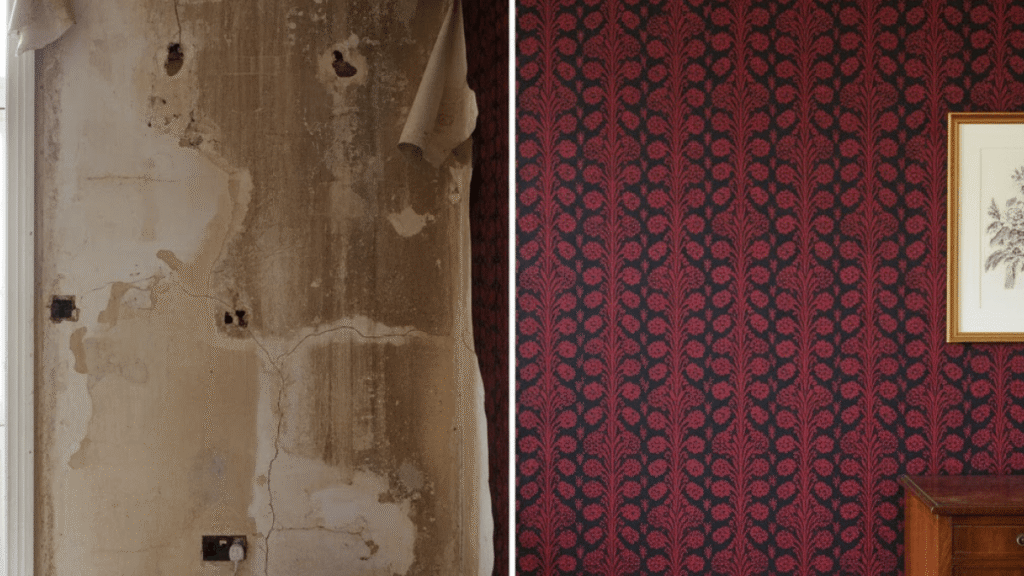
Real Project: Restoring a 1892 Drawing Room in Weybridge
The restoration of the Grade II-listed villa became necessary because its Lincrusta dado and Anaglypta ceiling had vinyl sheet coverings from the 1970s which obscured their original appearance. The previous restoration work produced marks on the plaster surface that caused historical paper separation from its original position.
Our approach:
- The project team removed the area through dry scraping before they used enzyme-based poultices to eliminate the adhesive substance.
- The repair work used NHL 2 hydraulic lime as the primary material to fix the lime-plaster.
- The wallpaper named ‘Chawton’ from Little Greene with breathable non-woven backing material provided a complete duplicate of Morris and Co.’s original damask design.
- The picture rail installation received perfectly integrated results through hand-cut mitres.
The final result delivered a Victorian-style room that combined authentic design with enhanced durability and improved fire safety and breathability. The local Conservation Officer approved the scheme without conditions.
4 Common Mistakes That Damage Heritage Interiors
The following common mistakes lead to expensive problems because inexperienced contractors who mean well tend to make these errors:
| Mistake | Risk | Regulation Breach? |
| Applying vinyl wallpaper directly to solid walls | Moisture becomes trapped which leads to timber decay and salt efflorescence development. | Likely violates Part C (resistance to moisture) |
| Using PVA as a primer on lime plaster | The process leads to an unbreakable barrier which causes blisters to form while the material starts to separate. | Contradicts BS 5282:2023 guidance |
| Ignoring pattern scale in period rooms | The modern prints which exceed normal dimensions create an unbalanced effect against the room’s existing dimensions. | Aesthetic misstep — devalues property |
| Skipping conservation consent (for listed buildings) | Enforcement notice, costly reversal | Breach of Planning Act 1990 |
Ready to Restore with Respect?
Your historic home requires safety regulations that protect its working areas while preserving its traditional charm.
Our professional wallpaper installation team will combine historic design elements with modern features to create a cosy atmosphere that preserves your space, filled with timeless stories.
You can speak to our cultural heritage specialists at the following contacts: The company offers free consultation services for residents of Surrey and South West London who live in Richmond, Kingston, Cobham and Asher.