In this article
Godalming town centre is one of the most distinctive places we work in Surrey. Church Street, the High Street and the lanes off them hold timber-framed buildings from the seventeenth century, rendered fronts, and walls of Bargate stone, the local sandstone that was quarried here until well into the twentieth century. Decorating these buildings is not the same job as repainting a modern house, and the difference is not just a matter of taste: it is about what the fabric will tolerate and what the council expects.
The plain rule is this. Godalming Town Centre has been a conservation area since March 1974, and its appraisal was adopted on 10 December 2013 as a material consideration for planning decisions. A listed frontage needs listed building consent for any alteration that affects its special character, including a change of colour; a like-for-like repaint using appropriate materials does not. For an unlisted building, repainting in the same colour is maintenance, but check the address on the council’s map before you change anything, because the appraisal is what officers weigh any application against.
Where the controls apply in Godalming
The Waverley conservation areas page records that Godalming was designated in March 1974 and extended in October 1984 and December 1989. The Town Centre appraisal (PDF, 1.4 MB), adopted in December 2013, counts 125 statutory listed buildings in the area — 122 Grade II, three Grade II*, and one Grade I, the Church of St Peter and St Paul — alongside fifteen heritage features and two buildings of local merit at 96 and 117 High Street.
The appraisal does not name an Article 4 direction for the town centre, and the council page does not list one. What governs decorating here is the listed-building regime and the appraisal’s description of character, which officers weigh against any application. The council’s listed buildings page puts it plainly: consent is required for any alteration that affects the special character of a listed building, and it is not required for like-for-like repairs using appropriate materials and techniques.
What the appraisal says the town is made of
The appraisal is unusually specific about materials, and that is where a decorator starts. The buildings date mainly from the seventeenth to the nineteenth centuries, sometimes masking earlier frames. Many are red brick, or red-brick-fronted over a timber frame underneath; others have exposed timber frames and painted render. Church Street, the appraisal says, has “arguably the most character in Godalming with many 17th century timber framed buildings”.
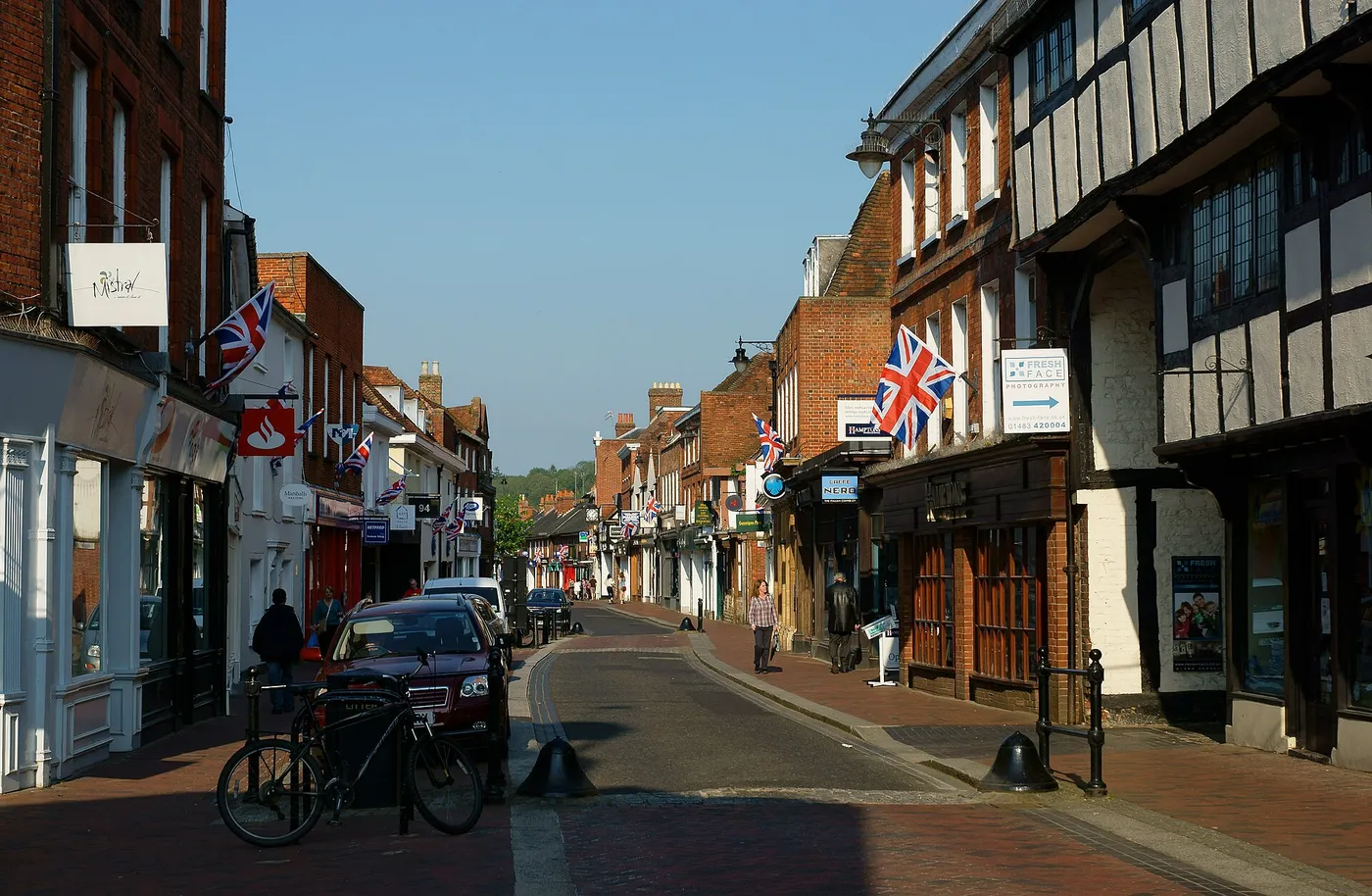
Photo: High Street, Godalming, Surrey by Peter Trimming, CC BY-SA 2.0 via Wikimedia Commons; resized.
Bargate stone runs through the whole town. The appraisal describes it as a local stone of sand, pebbles and hard calcareous sandstone, extensively used, with many buildings of local Bargate stone dressed in red brick. Hart’s Yard, off the High Street, is a good example of the mix: rendered timber-framed buildings, white painted brick and painted Bargate stone side by side. A reader from any of these streets will recognise the palette immediately.
Breathable finishes on lime render and old brick
The single most important decision on a Godalming frontage is what goes on the render. Old render here is lime-based, and lime works by absorbing and releasing moisture. Cover it with a modern acrylic or vinyl masonry paint and you trap that moisture inside the wall, which is how you get damp patches, peeling paint and blown render. The benefit of a breathable render is lost the moment the wrong paint goes over it.
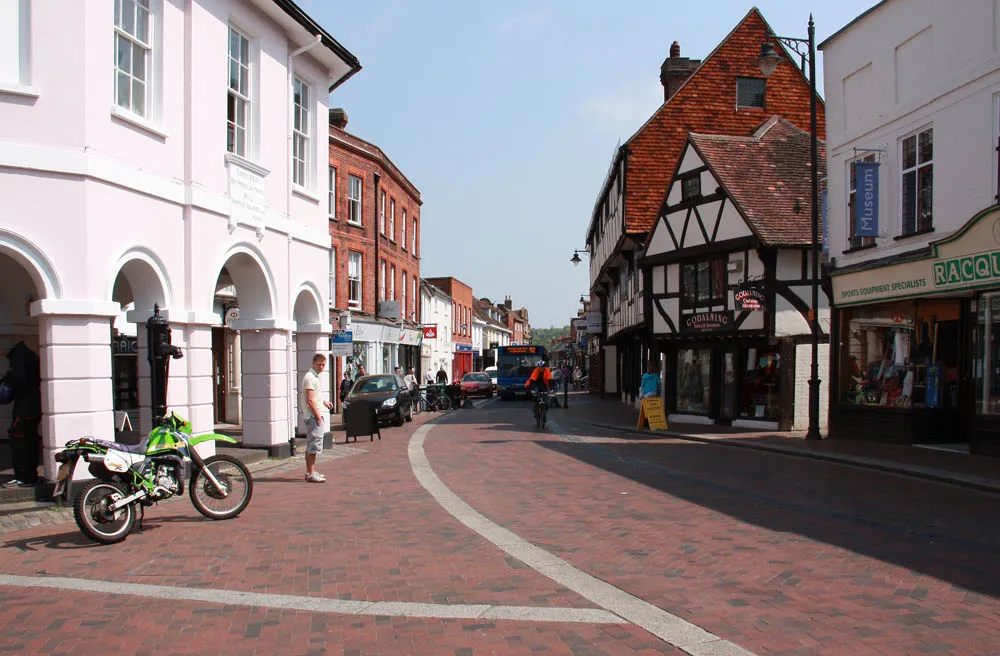
Photo: High Street, Godalming by John Salmon, CC BY-SA 2.0 via Wikimedia Commons; resized.
The test is the paint’s vapour permeability, its Sd value. For lime render we use only paints with an Sd value below 0.5, and the word “breathable” on a tin is not regulated, so the datasheet figure is the only thing to trust. In practice we reach for a silicate or mineral masonry paint, which bonds to the mineral surface rather than sitting on it as a film. The Earthborn silicate masonry paint range covers roughly six square metres per litre and is touch dry in about an hour, but it is a system, not a single tin: a silicate primer goes on bare, absorbent mineral surfaces, and a bonding primer on anything previously painted. Fresh lime render needs four to six weeks to cure before it sees any paint at all.
Never coat bare Bargate stone
Bargate stone is the one surface we will not paint. It is a soft, porous sandstone, and once it is coated the paint seals the surface and holds water against the stone, which spalls and flakes over time. The appraisal records painted Bargate stone in Hart’s Yard, so it has been done, but that is a reason to be careful, not a licence to repeat it. Where Bargate stone is already painted and sound, we leave it and match the surrounding scheme; where it is bare, it stays bare. The red brick dressings that frame it are a different matter — sound brick that has always been painted can be repainted, but bare brick should generally stay bare, because stripping paint off brick is destructive and irreversible.
Treating exposed oak framing
The exposed timber frames on Church Street are mostly oak, and they need a different hand from painted softwood joinery. Oak moves with the seasons, and a rigid, film-forming paint will crack along the grain and let water in behind it. Where the frame has always been painted, we strip back only what has failed, treat any soft or friable surface, and recoat with a flexible, microporous system that lets the timber breathe. Where the frame is bare and sound, we leave it bare — the appraisal values the exposed frame as part of the street’s character, and painting it would change that character, which on a listed building is exactly the kind of alteration that needs consent first.
Shopfronts and painted signs
The appraisal’s shopfront survey, carried out in 2012, found the majority of shopfronts acceptable to the conservation area, with a few that could be improved. It notes that most changes happen when a new proprietor brings in a corporate style, which usually means a colour change and new signage — and it observes that both “may not be controlled through the planning system”. That is not a green light; it is a gap the appraisal itself flags, and it recommends Waverley’s early-1990s shopfront design guidance be reviewed and adopted borough-wide. The second part of the appraisal (PDF, 2.2 MB) carries the Local Plan policy that encourages the retention and restoration of shopfronts where original detailing remains, and requires a high standard of design for advertisements, with internally illuminated signs not permitted.
The order of work on a Godalming frontage
This is where the decorator’s part of the job lives, and it is the part that decides whether the finish lasts. On a rendered, timber-framed frontage we work to a fixed sequence — the same one our masonry and render painting team follows across Godalming.
- Survey and record. Photograph the frontage and note what is painted, what is bare, and what is failing, so the finished scheme matches what was there.
- Check the consent position. Confirm whether the building is listed and whether the work is like-for-like or a change, and get the council’s answer in writing before any paint is opened.
- Wash down. Clean the render and joinery with water and a soft brush, never a pressure washer, which drives water into lime and soft stone.
- Repair before paint. Rake out loose render and repoint with a lime mortar, not cement, and let it cure. Cut out any soft timber and splice in new oak or softwood to match.
- Strip only what has failed. On painted render and joinery, remove loose and flaking coats back to a sound edge and feather the edges; leave sound paint in place.
- Prime the right surface. A silicate primer on bare mineral render, a bonding primer on previously painted render, and a flexible microporous primer on bare timber.
- Mist coat, then two full coats. On bare render, a thinned first coat soaks in and grips, followed by two full coats of the breathable masonry paint, each left to dry fully before the next.
- Cut in the joinery last. Windows, doors and the shopfront are painted after the render, so any drips or overspray land on a surface that is already finished and can be wiped clean.
- Signs and lettering. Historic painted signs are matched and restored by hand, not masked and sprayed, so the letterforms stay true to the original.
The figures on the tin set the pace. A silicate masonry paint covers around six square metres per litre, so a narrow two-storey frontage is a two-tin job, not a five-tin one, and the touch-dry time of about an hour means a coat can go on in the morning and be inspected the same afternoon. The real time is in the preparation: lime repairs cure over days, not hours, and a frontage that has been wrongly painted in the past can take longer to put right than one that has never been touched.
Frequently asked questions
Do I need permission to repaint my Godalming town centre property?
If the building is listed, listed building consent is needed for any alteration that affects its special character, which includes a change of colour. A like-for-like repaint using appropriate materials does not need consent. For an unlisted building, repainting in the same colour is maintenance. Check the address on Waverley’s map and, if in doubt, ask the council in writing before you start.
Can I paint the render on my timber-framed house?
Yes, but only with a breathable finish. Old render is lime-based and must be able to release moisture; a modern acrylic or vinyl masonry paint traps it and causes damp and blown render. Use a silicate or mineral paint with an Sd value below 0.5, primed correctly, and let fresh lime render cure for four to six weeks first.
Should I paint the exposed oak beams?
Generally not. Bare oak framing is part of the character the appraisal protects, and painting it changes that character — on a listed building that is an alteration needing consent. Where the frame has always been painted, strip only what has failed and recoat with a flexible, microporous system that lets the timber move and breathe.
What about the Bargate stone?
Leave bare Bargate stone bare. It is a soft, porous sandstone, and paint seals it and holds water against the surface, which makes it spall. Where Bargate stone is already painted and sound, we leave it and match the scheme around it. The red brick dressings can be repainted if they have always been painted.
Can I change the colour of my shopfront?
The appraisal notes that shopfront colour changes and new signage “may not be controlled through the planning system”, but it also recommends Waverley’s shopfront guidance be adopted borough-wide, and a listed shopfront needs consent for a change that affects its character. The safest course is to describe the change to the council and get its answer in writing before you paint.
How long does a proper job take?
Longer than a modern house, because of the preparation. Lime repairs cure over days, fresh render needs weeks before it is painted, and a frontage that has been wrongly painted in the past takes longer to strip back than one that has not. A single narrow frontage is usually a matter of days on site, spread over a week or two to allow for drying.